Our Sliding Scale: The Green Bottle Method
Cost is one of the most common reasons people put off starting therapy, and it is almost never the reason they say out loud. It usually sounds like "I'll look into it after the holidays," or "things are a little busy right now."
If that is where you are, I would like to make this part easy. So here is exactly what therapy with me costs, and how to find the number that fits your life.
My full fee is $225 per session. I also offer two reduced rates, $175 and $125, and you are the one who decides which one fits. There is no application to fill out, no pay stub to send, and no moment where you have to make a case for yourself.
Why I Offer a Sliding Scale
Fees usually get treated as a fixed fact of a practice, the way rent is. But a single price means the people most affected by financial stress are the ones least able to get support for it, which has always sat wrong with me. Especially in a practice built around high-achieving BIPOC and first-generation professionals, so many of whom are quietly holding up more than one household at a time.
A sliding scale does not fix that. What it does is make the door wider, and I would rather have a wider door.
It also only works because of the people at the top of the scale. If you are paying the full fee, you are the reason the reduced rates exist. I am genuinely grateful for that, and I want you to know it is doing something real for someone else.
How the Green Bottle Method Works
The framework I use was created by Alexis J. Cunningfolk, and I love it because it asks a kinder question than most sliding scales do.
The usual approach asks about your income, which turns out to be a poor measure of what anyone can actually afford. Two people earning the same amount can be in completely different situations depending on debt, dependents, medical costs, immigration status, whether they are sending money home, and whether there is anyone who would catch them if they fell.
Instead, the Green Bottle Method shows you three bottles at different fill levels and asks a simpler question: which one looks like your life right now?
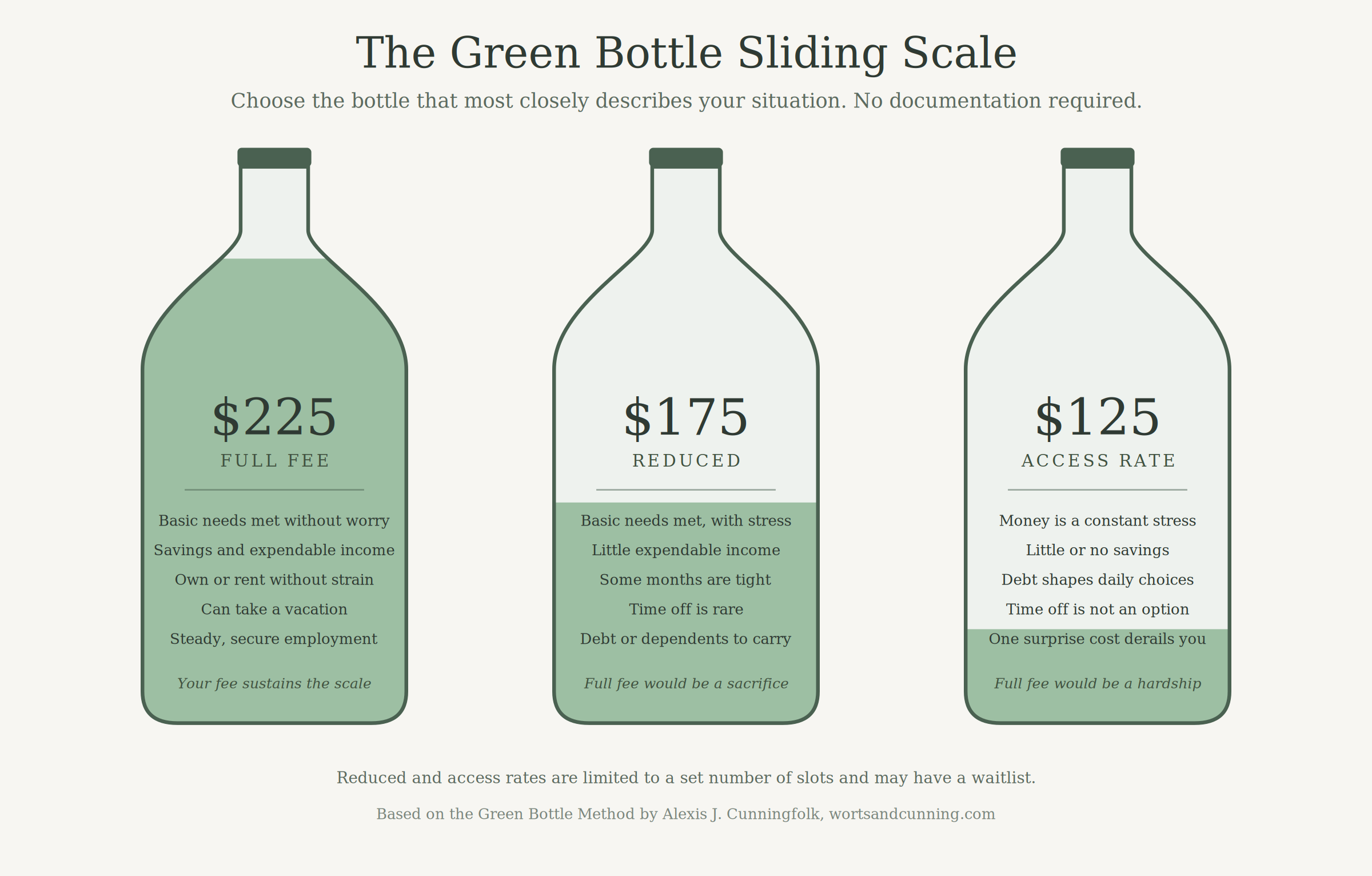
Choose the bottle that most closely describes your situation.
Sacrifice or Hardship
Cunningfolk draws a distinction I find genuinely useful, and it is the one I would invite you to sit with for a moment.
A sacrifice means paying the fee costs you something real. You skip a trip, you cook at home more often, you put off a purchase. It is inconvenient, and you can carry it.
A hardship means paying the fee costs you something you cannot afford to lose. Rent goes late. A prescription does not get filled. Someone who depends on you goes without.
If my full fee would be a sacrifice for you, the middle bottle is probably yours. If it would be a hardship, the third bottle is there, and it is there for exactly this reason. And if it would be neither, the full fee is where you belong, and choosing it holds the other two open.
Most people I talk with lean the same direction. They reach for a lower rate than their situation calls for, because asking feels uncomfortable, or because they are certain someone else has it worse. If that sounds like you, I understand it completely. I would still gently ask you to pick the bottle that is true rather than the one that feels most polite.
If that reluctance to claim what you need sounds familiar outside of money too, I wrote about where it tends to come from in Imposter Syndrome in BIPOC and First-Generation Professionals.
How to Choose
Look at the three bottles and pick the one that most closely describes your situation. Tell me which one when we talk, and that becomes your rate.
I will not ask for documentation, and I will not ask you to walk me through your finances. There is no audit coming.
That is a deliberate choice, and it rests on something. A scale like this runs on honesty, which is the same ground everything else in our work together will stand on. I am going to trust you here, the same way I will trust you in session.
Insurance and Out-of-Network Benefits
This is usually the next question, so let me answer it plainly.
One thing to know up front: the sliding scale applies only when you are paying me directly. If your care is billed to an insurer or an EAP, your cost is set by that plan, not by the scale.
Cigna Evernorth in California. I am in network with Cigna Evernorth for California clients. If that is you, the sliding scale does not apply, because your plan sets your cost. You will pay your copay or coinsurance, and your deductible may apply. Your plan can tell you the specifics, and I am happy to walk through it with you.
EAP benefits. I work with Modern Health and with Corporate Counseling and Associates. If your employer offers either, you may have a set number of sessions available at no cost to you. The sliding scale does not apply to EAP sessions, because those are billed directly to Modern Health or CCA rather than to you. It is worth checking whether you have this benefit, because many people do and never find out.
Everywhere else, including Florida and New York. I am out of network, which does not mean you are paying out of pocket with no help. Many plans reimburse a meaningful portion of out-of-network mental health care. There are two ways to pursue it:
A superbill. I provide an itemized receipt you submit to your insurer yourself. It reflects the rate you actually paid, including a sliding scale rate if that is what you are on.
Mentaya. A service that files out-of-network claims for you. Checking your benefits is free and takes a couple of minutes, and if a claim is reimbursed they take a 5% fee. If paperwork is the thing standing between you and using benefits you already pay for, this removes it.
I cannot promise what your plan will reimburse, since that is between you and your insurer. What I can tell you is that a surprising number of people have out-of-network benefits they have never used, and that finding out costs nothing.
Good Faith Estimates
If you are paying me directly, whether at my full fee or a sliding scale rate, you have the right to a written estimate of what your care will cost before we begin. It is called a Good Faith Estimate, and I will give you one without you having to ask.
It lays out the rate we agree on, how often we expect to meet, and what that adds up to over a period of care. If your rate changes, or if we change how often we meet, you get an updated one.
How many sessions that covers is the honest hard part. Until I have done an evaluation and we have actually started working together, I cannot really predict how long therapy will take. What I can tell you is that I typically see clients for somewhere between 8 and 15 sessions. Some people are working through something more complex, and that work can run longer than 15.
So your estimate will give you a realistic range rather than a single tidy number. If we end up somewhere different from what we planned, we will talk about it as we go, rather than letting it arrive as a surprise.
You can also ask for an estimate at any point, including before you decide whether to schedule. And if you ever receive a bill that is $400 or more above your estimate, you have the right to dispute it through a federal process, and I will help you sort it out rather than leaving you to it.
If anything about the numbers is ever unclear, please just ask me. I would much rather spend a few minutes on it than have you carrying around a question about money.
A Note on Availability
I want to be straightforward with you about this part. Reduced and access rate slots are limited. I hold a set number of them, and when they are full, they are full.
If the rate you need is not open when you reach out, I will tell you honestly rather than leaving you to wonder. I can add you to the waitlist, and I can point you toward something in the meantime.
One place I recommend often is Open Path Psychotherapy Collective, a nonprofit network of vetted therapists offering care at reduced rates across the US and Canada. After a one-time membership fee of $65, sessions generally run $40 to $70, and sessions with student interns are $30. If you need something more affordable than my lowest rate, it is a genuinely good place to look, and I would much rather see you start somewhere than wait.
A referral is not me closing a door on you. Sometimes it is the most useful thing I have to offer.
If Your Situation Changes
It probably will, in one direction or the other, and that is completely fine.
If things get harder, tell me and we will adjust. If things get easier, I would love for you to tell me that too. People move up this scale as well as down, and the ones who do are part of why it stays open for the next person who needs it.
This is a conversation, not something you signed once and have to live with.
Getting Started
If any of this makes therapy feel a little more possible than it did ten minutes ago, then it is doing its job.
Book a free consultation below. We will talk about what brought you here, whether I am the right fit for you, and which bottle is yours. You will not need to prove anything to anyone.
Related reading: Flourish as a First-Generation Professional, on navigating a workplace nobody prepared you for.
-
No. There is no application, no documentation, and no income verification. You choose the rate that matches your circumstances and let me know when we talk. The method runs on honest self-assessment, which is the same foundation the rest of our work will rest on.
-
Ask yourself whether the higher rate would be a sacrifice or a hardship. A sacrifice means giving up something you can afford to give up. A hardship means it costs you something you actually need. If it is a sacrifice, take the higher rate. If it is a hardship, please take the lower one. And if you are torn mostly because asking feels uncomfortable, that is worth noticing gently rather than obeying.
-
That is a real situation and it deserves a real answer rather than a shrug. Open Path Psychotherapy Collective is a nonprofit network offering sessions at $40 to $70 after a one-time $65 membership, with student intern sessions at $30. Community mental health centers and university training clinics in California, Florida, and New York are also worth looking into. Reach out to me anyway if you would like, and I will help you find something that works.
-
I am in network with Cigna Evernorth for clients in California, and I work with Modern Health and Corporate Counseling and Associates for EAP benefits. Everywhere else, including Florida and New York, I am out of network. I provide superbills you can submit yourself, or you can use Mentaya, which files out-of-network claims on your behalf and charges 5% of a successful reimbursement. Many people have out-of-network benefits they have never used, and checking costs nothing.
-
Tell me and we will adjust, in either direction. People move up this scale as well as down. If things get harder, the lower rate is there for you. If things get easier, moving up helps keep a slot open for someone else.